Can a Palletizer Reduce Labor Costs? (Short Answer: Yes — Dramatically)
According to the U.S. Bureau of Labor Statistics, manual material handling accounts for more than 30% of all workplace injuries, and companies spend up to 50% of their operational labor budget on repetitive tasks like stacking, lifting, and palletizing
Most manufacturers know palletizing is one of the most physically demanding, injury-prone, and labor-intensive parts of production. What many don’t realize is just how much money an automated palletizer can save — not just in wages, but in injuries, turnover, downtime, and operational inefficiencies.
Here’s a breakdown of how palletizers reduce labor costs, backed by real industry data and our work distributing APT’s MOD-PAL robotic palletizing systems.
How Palletizers Actually Reduce Labor Costs
A palletizer doesn’t just replace “one job.” It removes entire categories of labor expense:
1. Fewer Workers Required on the Line
Manual palletizing usually requires 2–4 workers per line depending on weight, speed, and shift length.
A robotic palletizer?
0–1 operators, primarily for oversight.
Most facilities see:
- 50–75% reduction in line labor
- Immediate elimination of repetitive lifting roles
- Reallocation of workers to higher-value tasks
2. Lower Injury & Ergonomic Costs
Repetitive heavy lifting = injuries. Injuries = workers’ comp, insurance increases, lost time, rehiring, retraining, and overtime.
According to the Pasco Systems analysis, automated palletizing can cut labor costs up to 50%. A single back or shoulder injury can cost $40,000-$100,000 and a palletizer can eliminate the root cause entirely.
3. Fewer Overtime Hours
When production ramps up, palletizing is one of the first areas to require overtime or additional shifts.
Robotic palletizers don’t get tired. They run:
- Third shift
- Weekends
- Peak season
- Seasonal rush
…all without extra payroll cost
4. Reduced Turnover & Training Costs
Turnover in manual palletizing roles is brutal — some plants experience 150%+ annually.
A palletizer immediately reduces churn in the highest-fatigue positions.
According to the Pasco resource:
A company running multiple shifts can save high five-figures annually in training, onboarding, and recruitment simply by automating palletizing.
This isn’t theory — it’s math.
5. Higher Productivity with Lower Headcount
Let’s talk speed.
A manual team might average 6–10 cases/minute depending on fatigue. A robotic palletizer averages 20–35+ cases/minute, consistently, without breaks.
This means you can grow production without adding labor — one of the biggest long-term ROI drivers.
Case Study: How One Manufacturer Saved Big With Automation
A plant analyzed by Pasco Systems had:
- Multiple lines
- High manual labor dependence
- Rising injury costs
- High overtime
- High turnover
The results after installing automated palletizing:
- Reduced 3–4 workers per shift
- Eliminated most manual lifting injuries
- Slashed overtime across all shifts
- Saved hundreds of hours of labor per month
- Significantly reduced annual training & onboarding costs
- Improved line consistency and reduced product damage
Total annual savings? Six figures — every year.
The equipment paid for itself far faster than expected.
The Hidden ROI of Palletizers (Most People Miss This)
Many manufacturers only calculate ROI based on hourly wages. That’s just one slice of the pie.
Real ROI includes:
- Reduced injuries
- Reduced overtime
- Lower churn
- Lower onboarding/training
- Fewer production slowdowns
- Fewer quality defects
- Higher throughput without increased staffing
For many operations, palletizers aren’t just cost-effective — they’re the single highest-ROI automation investment.
So… Can a Palletizer Reduce Labor Costs?
Absolutely. Far more than most manufacturers realize.
✔ rising labor costs ✔ difficulty hiring ✔ overtime issues ✔ injuries related to lifting ✔ inconsistent stacking ✔ slow production growth
…then a robotic palletizer will not just improve operations — it will directly and significantly reduce your annual labor spend.
A palletizer automates the repetitive task of stacking boxes, bags, or containers onto pallets. This reduces the number of employees required for manual lifting, eliminates overtime, and minimizes workplace injuries—all major contributors to operational labor costs.
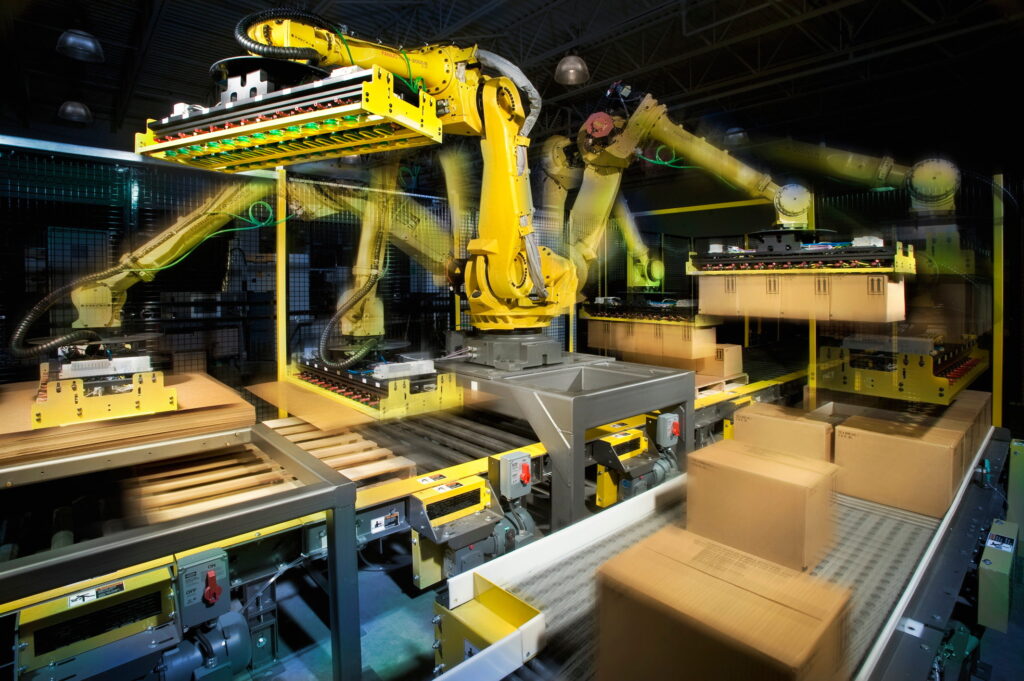
Robotic palletizers typically have low maintenance costs thanks to reliable components like FANUC robotic arms, which are designed for long lifespans and minimal downtime. Preventative maintenance is simple and predictable, lowering long-term operating cost.
Most palletizers pay for themselves within 1–3 years depending on labor rates, production volume, and the extent of automation. Many companies see ROI even faster when replacing multiple manual labor positions.
Yes. Manual palletizing is one of the leading causes of workplace strains, back injuries, and repetitive-motion incidents. Robotic palletizers eliminate heavy lifting and improve workplace safety, reducing injury-related downtime and workers’ compensation costs.