As personal care brands continue to expand product lines and increase production volumes, packaging operations must keep pace without sacrificing quality or consistency. From lotions and shampoos to cosmetics and health products, manufacturers rely on efficient packing and palletizing machines to maintain throughput, reduce labor strain, and ensure products move safely through the end of the line.
For personal care manufacturers, end-of-line automation is no longer just about speed — it’s about flexibility, reliability, and scalability.
Why End-of-Line Automation Matters in Personal Care Packaging
Personal care products often come in a wide variety of container shapes, sizes, and materials. This variability creates challenges during packing and palletizing, especially in operations that still rely heavily on manual handling.
Automated packing and palletizing systems help address these challenges by:
- Reducing repetitive manual labor and injury risk
- Improving consistency in case packing and pallet patterns
- Supporting frequent changeovers between SKUs
- Maintaining steady throughput during peak production periods
When properly integrated, automation allows manufacturers to focus more on product quality and less on downstream bottlenecks.
Key Considerations for Packing and Palletizing Personal Care Products
Not all automation solutions are created equal — especially in the personal care industry. Successful systems must be designed around real-world production requirements.
Important factors include:
- Gentle handling for lightweight or fragile containers
- Compact footprints that fit within existing packaging lines
- Flexible programming to support multiple product formats
- Clean, consistent pallet loads for storage and distribution
This is where purpose-built packing and palletizing equipment becomes essential.
Robotic Palletizing Solutions for Personal Care Manufacturers
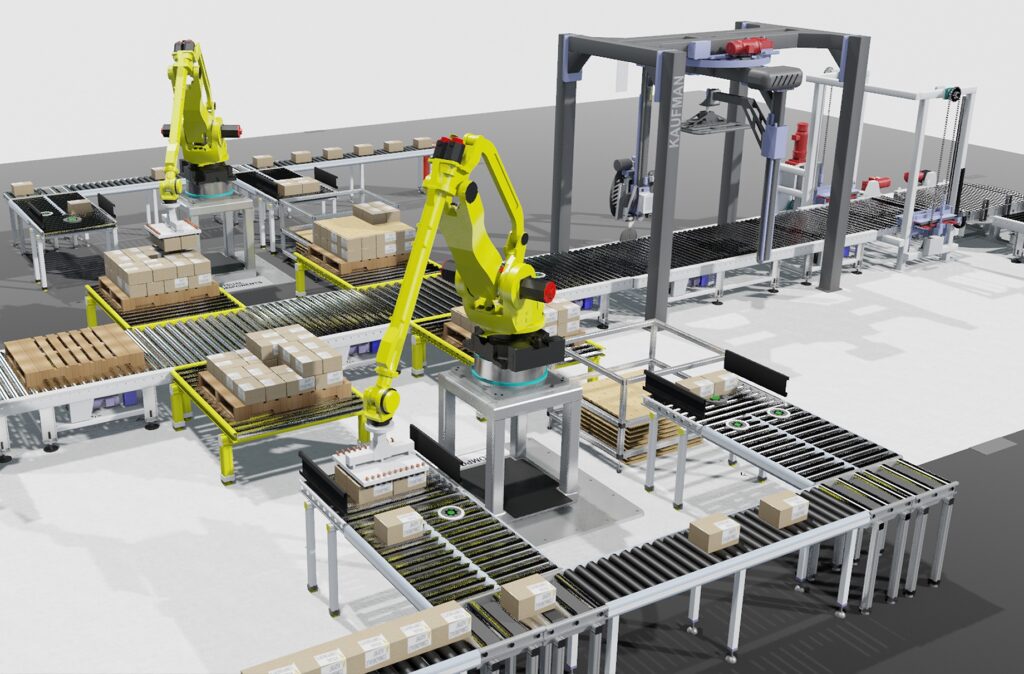
Robotic palletizing has become one of the most effective ways to automate end-of-line operations for personal care products. Compared to traditional fixed automation, robotic systems offer greater adaptability and easier reconfiguration as product demands change.
Manufacturers working with automation specialists like APT Manufacturing benefit from systems designed specifically for modern packaging environments. APT’s palletizing platforms are engineered to handle a wide range of case sizes while maintaining precise placement and repeatability.
MOD-PAL Robotic Palletizers: Built for Flexible End-of-Line Automation
For personal care operations seeking scalable automation, the MOD-PAL robotic palletizer provides a versatile solution for packing and palletizing machines across multiple production scenarios. These systems are designed to integrate seamlessly with existing conveyors, case packers, and labeling equipment.
Collaborative Palletizing for Growing Personal Care Operations
Not every personal care manufacturer requires a fully enclosed robotic cell. For operations with limited space or lower throughput requirements, collaborative palletizing systems offer an effective alternative.
The MOD-PAL 30 collaborative palletizer is designed to work safely alongside operators while still delivering the benefits of automation. These systems are especially well-suited for growing personal care brands that want to automate packing and palletizing without major facility modifications.
Benefits of collaborative palletizing include:
- Faster deployment compared to traditional robotic cells
- Smaller footprints for space-constrained facilities
- Simplified operation and programming
Building a Scalable End-of-Line Strategy
Investing in the right packing and palletizing machines allows personal care manufacturers to scale production without rebuilding packaging lines from scratch. Whether implementing robotic palletizing, collaborative solutions, or a combination of both, working with our Pocono Search Partners creates a more predictable and efficient end-of-line process.
Working with an experienced automation partner ensures systems are selected and configured to meet real production demands — today and as product lines evolve.
Packing and palletizing machines are used at the end of the production line to organize, case pack, and stack personal care products for storage and distribution. These systems help manufacturers move products efficiently while maintaining consistency, reducing labor, and preventing damage during handling.
Personal care manufacturers often handle high product variety, lightweight containers, and frequent changeovers. Automated palletizing improves consistency, reduces repetitive manual labor, and helps maintain steady throughput as production volumes increase.
Yes, robotic palletizers are well suited for personal care products because they can handle a wide range of case sizes, weights, and pallet patterns. Robotic systems provide flexibility for changing SKUs while maintaining precise and repeatable pallet builds.
Traditional palletizing systems typically operate inside fenced robotic cells, while collaborative palletizers are designed to work safely alongside operators. Collaborative palletizing systems are ideal for personal care manufacturers with limited floor space or lower throughput requirements.
Most modern packing and palletizing machines are designed to integrate with existing conveyors, case packers, and labeling equipment. Proper system design ensures smooth product flow without requiring major changes to upstream packaging operations.
Choosing the right solution depends on production volume, available floor space, product mix, and future growth plans. Working with an experienced automation partner helps ensure the system is sized correctly and remains scalable as packaging demands evolve.
Key advantages include:
- Consistent pallet patterns across varying case sizes
- Reduced labor requirements without sacrificing throughput
- Reliable operation in high-mix, high-volume environments